
Water plays an important role in manufacturing, processing, cleaning, cooling, and several other industrial activities. Once used, however, that water may contain oils, suspended particles, organic matter, chemicals, dissolved substances, and contaminants associated with the production process.
This is why industrial wastewater treatment needs to be planned according to the actual characteristics of the wastewater rather than treated as a standard utility requirement.
For industries operating in Nagpur and across Maharashtra, SK Enterprises provides water and wastewater treatment solutions designed around different industrial applications and site conditions.
Why Industrial Wastewater Requires Careful Assessment
Wastewater varies significantly between industries.
A food-processing facility may generate water containing high levels of biodegradable organic matter. Engineering and metal-processing units may need to manage oil, suspended particles, chemicals, or process residues.
Even two factories manufacturing similar products can generate different wastewater because production methods, raw materials, water consumption, and cleaning practices differ.
The first step should therefore be understanding what the wastewater contains.
Important parameters commonly evaluated include:
- Daily wastewater volume
- Peak wastewater flow
- pH
- Organic load
- Suspended solids
- Dissolved substances
- Oil and grease
- Industry-specific contaminants
Representative wastewater analysis helps engineers select appropriate treatment stages.
Why Flow Variation Matters
Industrial wastewater is not always generated evenly throughout the day.
Batch production, cleaning cycles, shift changes, and process discharges can create sudden variations in flow and pollutant concentration.
If these variations are ignored, treatment performance can become unstable.
Understanding average and peak conditions allows the system to be designed around actual production patterns rather than theoretical daily averages.
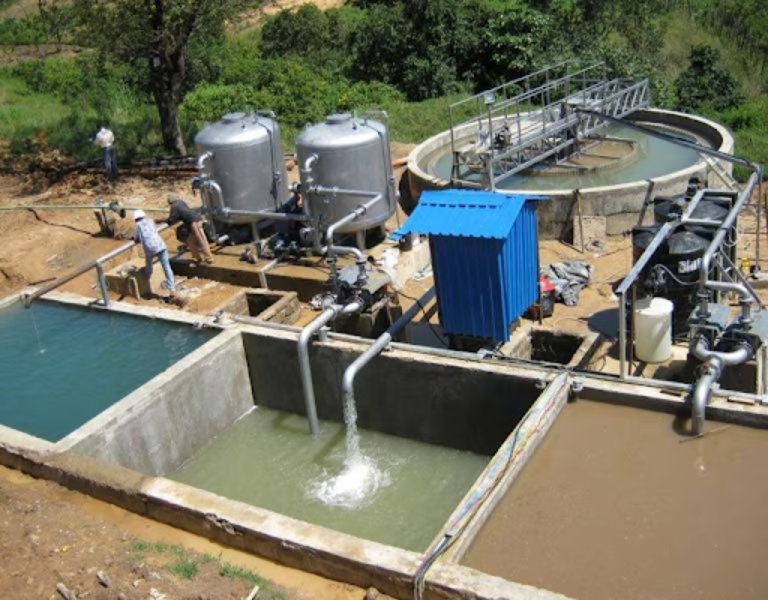
Treatment Usually Happens in Multiple Stages
Industrial wastewater generally requires several treatment processes working together.
Initial stages may remove larger solids and floating material. Physical and chemical processes can then help separate contaminants or adjust water characteristics.
Where biodegradable pollutants are present, biological treatment may also be appropriate.
Additional filtration and polishing can be incorporated when the required treated-water quality demands it.
Each stage should solve a defined problem identified during wastewater assessment.
Operating Requirements Matter as Much as Design
A treatment system needs to remain manageable after installation.
Businesses should evaluate electricity consumption, chemical requirements, operator involvement, routine maintenance, testing, equipment accessibility, and residual waste handling before finalizing a project.
An unnecessarily complicated system can create avoidable operating expenses, while an oversimplified system may struggle with changing wastewater conditions.
Think About Future Production
Industrial facilities rarely remain unchanged.
Production may increase, additional manufacturing lines may be introduced, or water-use patterns may change.
Allowing reasonable flexibility during planning can help businesses avoid major modifications later.
For industries in Nagpur, local site conditions, available installation area, operational resources, and Maharashtra's applicable environmental requirements also need consideration.
SK Enterprises works with industrial facilities to understand wastewater characteristics and develop treatment approaches suited to operational requirements.
Effective industrial wastewater treatment begins with knowing what enters the treatment system, how much is generated, and what quality needs to leave it. When these questions are answered before equipment selection, industries can develop wastewater infrastructure that is easier to operate, maintain, and adapt as production requirements evolve.