Wastewater treatment starts with controlling what enters the plant, how quickly it arrives and what the treated water must be used for. By the end, you will be able to follow each treatment stage, estimate capacity from defensible flow data, compare compact configurations and identify when sewage requires an ETP instead.
Key takeaways
- Measure peak hourly flow, not just average daily sewage generation.
- Choose MBBR, SBR, MBR or aeration after checking land, power and operator capacity.
- Specify BOD, TSS, ammonia and faecal coliform limits before requesting quotations.
- Keep screens, sludge handling, ventilation and access in the compact STP layout.
From Inlet Screen to Treated-Water Storage: The Compact STP Process
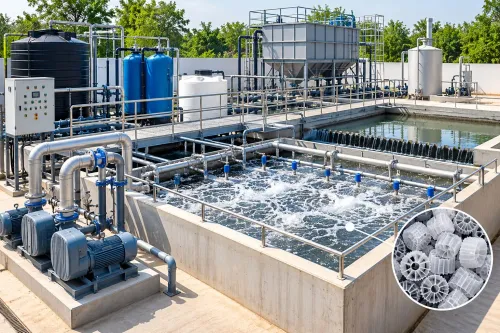
Sewage enters a compact wastewater treatment system through an inlet chamber, where a bar screen removes rags, plastics and other large debris. The plant then removes grit and settles flow variations before biological treatment; a smaller footprint comes from process intensification, not from deleting essential stages.
- Screen and grit removal: Clean the screen regularly and remove sand, because blocked screens restrict flow while grit damages pumps and agitators.
- Equalisation: Hold incoming sewage in a tank and mix it before pumping forward. This buffers morning peaks, tanker discharges and uneven occupancy.
- Biological aeration: Blowers supply oxygen to microorganisms that reduce biodegradable organic matter and, where designed, convert ammonia. Do not send solvents, heavy metals, concentrated chemicals or high-salinity effluent into this stage.
- Secondary clarification: Let biological solids settle. Return part of the settled sludge to maintain the reactor population and withdraw excess sludge before it accumulates.
- Filtration and disinfection: Pass clarified water through pressure filters or another specified polishing stage, then disinfect with chlorine, ultraviolet light or an approved alternative.
- Treated-water storage: Store the final water in a covered tank, with separate pumps and piping for flushing, gardening, cooling or process reuse.
Provide access for screen cleaning, blower removal, sludge withdrawal and filter maintenance. Confirm the required water quality and discharge route with the project consent and Maharashtra Pollution Control Board conditions; reuse water can need tighter pathogen, solids, hardness or salinity control than basic discharge water.
How to Size a Compact STP for Nagpur’s Real Wastewater Flow
A 100-person building does not automatically need a 10,000-litre-per-day plant. Calculate actual occupancy and water use, then convert the wastewater pattern—not floor area alone—into hydraulic and organic loads.
1. Establish the design population and occupancy. Count residents, staff, visitors, students, patients, or guests who are present during each shift. For a preliminary estimate, wastewater is often taken as about 80% of water supplied; replace that assumption with flow-meter readings covering weekdays, weekends, and seasonal occupancy.
2. Separate average and peak flow. Record average daily flow, peak hourly flow, morning surges, infiltration during monsoon, tanker discharges, and batch releases from kitchens or laundries. A plant sized only for daily volume can overflow or short-circuit during morning peaks. Size pumps, screens, pipes, and equalization for those peaks.
3. Test wastewater characteristics before selecting capacity. Measure BOD, COD, TSS, pH, oil and grease, ammonia, and salinity. In a compact sewage treatment plant for process in Nagpur, segregate solvents, heavy metals, concentrated chemicals, disinfectant shocks, and high-COD effluent; pretreat them through an ETP instead of feeding them to the biological reactor.
4. Add controlled buffering and future allowance. An equalization tank in a compact STP plant in Nagpur smooths shift-based or batch flows, but mixing or aeration is necessary to prevent septic conditions. Confirm the reuse point—flushing, irrigation, cooling, or process water—before fixing treatment capacity and treated-water quality.
MBBR, SBR, MBR or Extended Aeration: Which Compact Layout Fits the Site?
Choose the process around hydraulics, outlet quality, operator access and available power—not the smallest catalogue footprint. A small sewage treatment plant in Nagpur needs an equalization tank when hotels, hospitals, malls or shift-based facilities send uneven flows.
For an SBR, provide buffer volume or multiple reactors; a single tank cannot receive unrestricted sewage while settling or decanting.
| Process | Main advantage | Critical limitation |
|---|---|---|
| MBBR | Continuous flow; compact reactor with attached biomass | Needs downstream clarification and media retention screens |
| SBR | Combines aeration, settling and decanting in one basin | Requires equalization or multiple reactors for continuous inflow |
| MBR | Produces low-turbidity water suitable for higher-grade reuse | Membranes need regular cleaning, skilled operation and higher energy |
| Extended aeration | Simple, forgiving biological treatment | Larger aeration volume and ongoing blower power |
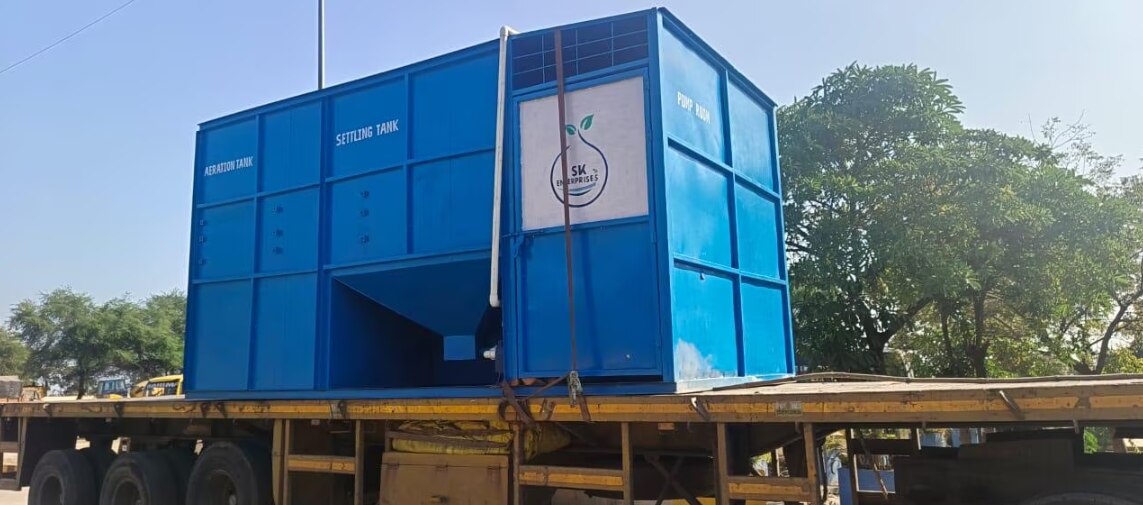
Compare installation formats separately. Above-ground plants simplify inspection and equipment removal, while underground tanks save surface space but need ventilation, safe entry controls and protection from groundwater ingress. Containerized systems speed deployment, yet summer heat, corrosion and internal access require design attention.
Skid-mounted equipment suits a prepared plant room; it does not remove the need for tanks, drainage or lifting clearance. Modular construction allows staged capacity increases when the civil layout leaves pipe and electrical space.
Specify screen-cleaning access, blower removal, sludge withdrawal, diffuser or membrane servicing, chemical storage and a route for replacement equipment. Select MBBR or extended aeration for steady continuous flow, SBR where batch operation suits the site, and MBR only when reuse quality justifies its maintenance and power demands.
When Sewage Needs an ETP, and How to Specify Treated-Water Quality
Domestic sewage comes from toilets, bathrooms, kitchens and handwashing. Industrial effluent comes from production, laboratories, laundries, workshops or hospitals and may contain solvents, heavy metals, concentrated chemicals, high salinity, disinfectants or unusually high COD.
Segregate those streams and use an ETP or pretreatment; sending them directly to a biological STP can kill the organisms that remove carbon and ammonia.
1. Map every drain before selecting a compact wastewater treatment system. Record source, daily flow, cleaning chemicals, batch discharges and shock loads. Keep process wastewater, kitchen grease and stormwater out of the domestic sewage line.
2. Name the outlet’s job: toilet flushing, gardening, cooling-tower make-up, laundry, process reuse or discharge. Set limits for TSS, pathogens, hardness, salinity and scaling risk for that job, not just for daily capacity. Cooling and process users need closer control than landscape irrigation.
3. Match the specification to the discharge route and Maharashtra Pollution Control Board consent. Include flow, pH, BOD, COD, TSS, oil and grease where relevant, plus ammonia or total nitrogen when the consent or reuse equipment requires them. There is no single “Nagpur STP” limit for every outlet.
4. Verify performance under real operating conditions. Sample during representative loading and peak periods, test through an accredited laboratory, and check microbiological quality after disinfection. A clear-looking outlet proves nothing about pathogens or dissolved pollutants.
Give the source map, reuse target and consent conditions to S K ENTERPRISES before equipment selection. The final acceptance record should compare laboratory results with each specified limit and document flow, sampling time, disinfection status and corrective action for any failure.
Related products
 | SEWAGE TREATMENT PLANT COMPACT SEWAGE TREATMENT PLANT A compact sewage treatment plant (STP) is a small, self-contained unit that purifies wastewater in a small footprint, using physical, biological, and... View product → |
 | SEWAGE TREATMENT PLANT A packaged sewage treatment plant (PSTP) is a compact, pre-engineered, and self-contained system designed to treat wastewater from domestic or... View product → |
Installation, Commissioning and Operation Conditions That Decide Performance
Monsoon inflow can overwhelm a compact STP plant in Nagpur if roof drains, stormwater and groundwater enter the sewage line. Provide separate rainwater drainage, a screened inlet sized for peak flow, overflow protection and enough equalization volume for sudden surges.
Equalization is vital for hotels, hospitals, malls and shift-based factories: mixing or aeration prevents septic conditions while controlled pumping smooths the biological load.
Summer brings lower flow and more concentrated sewage. Prevent long stagnation, maintain adequate aeration and retain a minimum operating volume; do not run the plant as though its design flow arrives every hour. Select blowers with efficient turndown, measure dissolved oxygen and provide standby power for aeration, pumps, controls and disinfection.
A compact STP installation must preserve access despite its small footprint. Leave a route for screen cleaning, sludge withdrawal, blower and pump lifting, diffuser or membrane servicing, chemical handling and ventilation.
Commission in controlled stages:
- Leak-test tanks and pipelines, then check pump and blower rotation.
- Calibrate flow, level and alarm instruments.
- Test control-panel interlocks, emergency stops and generator changeover.
- Increase loading gradually and train the operator on logs, alarms and sampling.
- Judge biological performance after biomass acclimatisation, not from an immediate sample.
Remove waste sludge on a defined schedule, dewater or thicken it as designed, store it without leakage and use an authorised disposal route. For an SBR, provide buffer volume or multiple reactors; one reactor settling or decanting cannot accept unrestricted inflow without overflow, short-circuiting or bypass.
Frequently asked questions
What stages does a compact sewage treatment plant use?
A compact STP uses inlet screening, grit removal, flow equalisation, biological treatment, solids separation, disinfection and treated-water storage. A smaller footprint comes from intensifying these stages, not removing essential treatment steps.
How do you size a compact STP for Nagpur?
Use measured average and peak flows, occupancy, water consumption, infiltration and seasonal variation. Size tanks and equipment for peak hourly flow, while checking biological loading from BOD, COD, TSS, nitrogen and grease.
Which compact STP process should you choose: MBBR, SBR, MBR or extended aeration?
MBBR suits steady flows and simpler operation; SBR suits batch treatment and variable flows; MBR provides high-quality reuse water in a small footprint; extended aeration offers a familiar process but needs more tank volume and aeration energy.
When does sewage need an ETP instead of an STP?
Use an STP for domestic sewage. Use an ETP when wastewater contains process chemicals, solvents, oils, heavy metals, high-strength organics or other industrial contaminants that domestic sewage treatment is not designed to remove.
Related products
 | SEWAGE TREATMENT PLANT Containerized sewage treatment plants are emerging as a sustainable, adaptable, and efficient solution for wastewater management. View product → |
 | SEWAGE TREATMENT PLANT Modular sewage treatment plants are transforming the wastewater treatment industry by providing a flexible and efficient alternative to conventional... View product → |
 | SEWAGE TREATMENT PLANT An Underground Sewage Treatment Plant (USTP) is a compact sewage treatment system designed to be installed underground, offering a space-saving... View product → |
Keywords