
A residential society, hospital, hotel, educational campus, and commercial complex may all generate sewage, but their daily water-use patterns are rarely identical. Occupancy, peak usage, available space, operating hours, and future expansion can all influence how a treatment system should be planned.
This is why customized sewage treatment can be more practical than selecting a standard system purely according to capacity.
SK Enterprises provides sewage and wastewater solutions for different property categories in Nagpur, where treatment requirements are evaluated according to site conditions and actual usage patterns.
Every Property Generates Sewage Differently
Residential developments commonly experience high water consumption during morning and evening hours.
Hotels may experience changing loads depending on occupancy, restaurants, laundry activities, and events.
Educational institutions can have lower wastewater generation during weekends and vacations, while hospitals may operate continuously.
These differences influence both treatment capacity and operating strategy.
What Should Be Studied Before Designing the System
A site assessment should consider:
- Number of occupants
- Average sewage generation
- Peak flow
- Available installation area
- Operating schedule
- Desired treated-water quality
- Maintenance access
- Operator availability
- Future occupancy
- Water reuse requirements
Ignoring these factors can result in a system that is either unnecessarily large or unable to manage peak conditions.
Capacity Alone Does Not Define a Good System
Two properties may generate the same total volume of sewage each day while requiring different treatment configurations.
One may have steady wastewater generation throughout the day, while another experiences concentrated peak loads.
Similarly, a large open property may have enough installation space for a conventional layout, while a compact commercial building may require a system planned around tighter space limitations.
This is where site-specific planning becomes important.
Maintenance Should Influence Design
A treatment system should not be designed only around its commissioning-day performance.
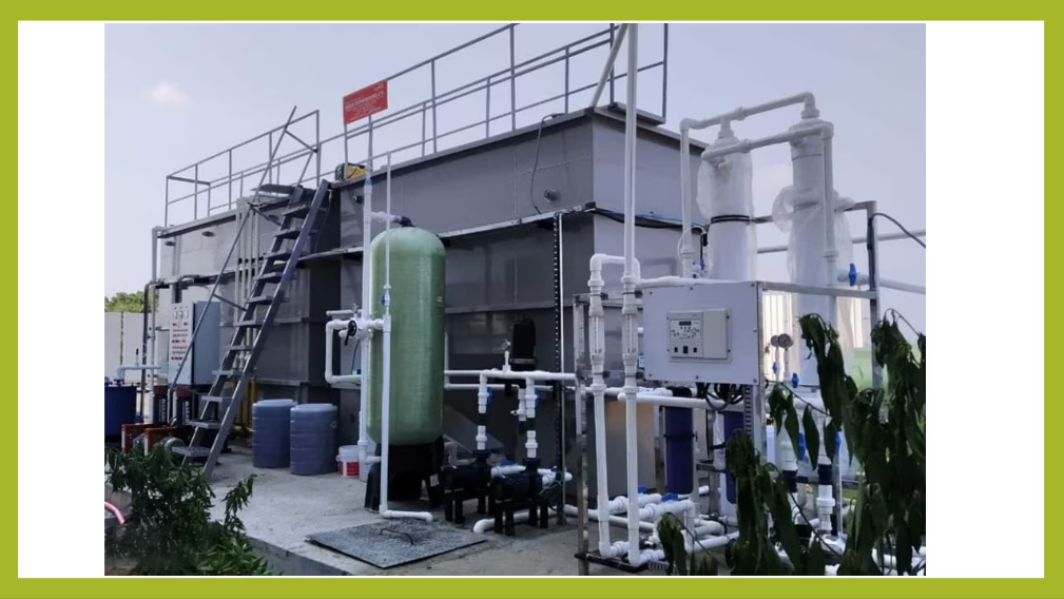
Pumps, blowers, filters, tanks, pipelines, and control equipment require inspection and maintenance throughout the operating life of the system.
Equipment should therefore remain accessible for routine checks, servicing, cleaning, and component replacement.
Operators also need clear procedures for regular monitoring and maintenance. A technically advanced system that is difficult to access or operate can create unnecessary challenges over time.
Future Requirements Should Be Considered
Residential and commercial developments can change after the initial treatment system is installed.
Occupancy may increase, additional buildings may be commissioned, operating hours may change, or water-consumption patterns may evolve.
Considering reasonable future demand during the planning stage can reduce the need for extensive modifications later.
This is particularly useful for developments where expansion has already been planned in phases.
Site Conditions Influence Treatment Planning
Available installation space, existing plumbing arrangements, accessibility for maintenance, occupancy patterns, and future expansion can influence how a sewage treatment system should be planned.
These practical site factors should be assessed before finalizing treatment capacity, equipment layout, tank positioning, piping arrangements, and the overall operating approach.
A site assessment can also identify practical limitations early. Restricted access, limited equipment space, existing utility lines, or difficulties in carrying out future maintenance can affect the final configuration.
Addressing these factors during planning is generally more practical than making significant changes after installation.
SK Enterprises works with residential, commercial, hospitality, healthcare, and institutional customers in Nagpur to evaluate sewage-treatment requirements based on individual project conditions.
Effective customized sewage treatment is therefore not simply about changing the size of a tank or selecting equipment from a catalogue. It involves understanding how a property uses water, when sewage is generated, what space is available, how the system will be operated, and how requirements may change in the future.
A site-specific approach helps align treatment capacity, layout, accessibility, and operating requirements with the actual needs of the property, making the treatment system more practical to manage throughout its operating life.