
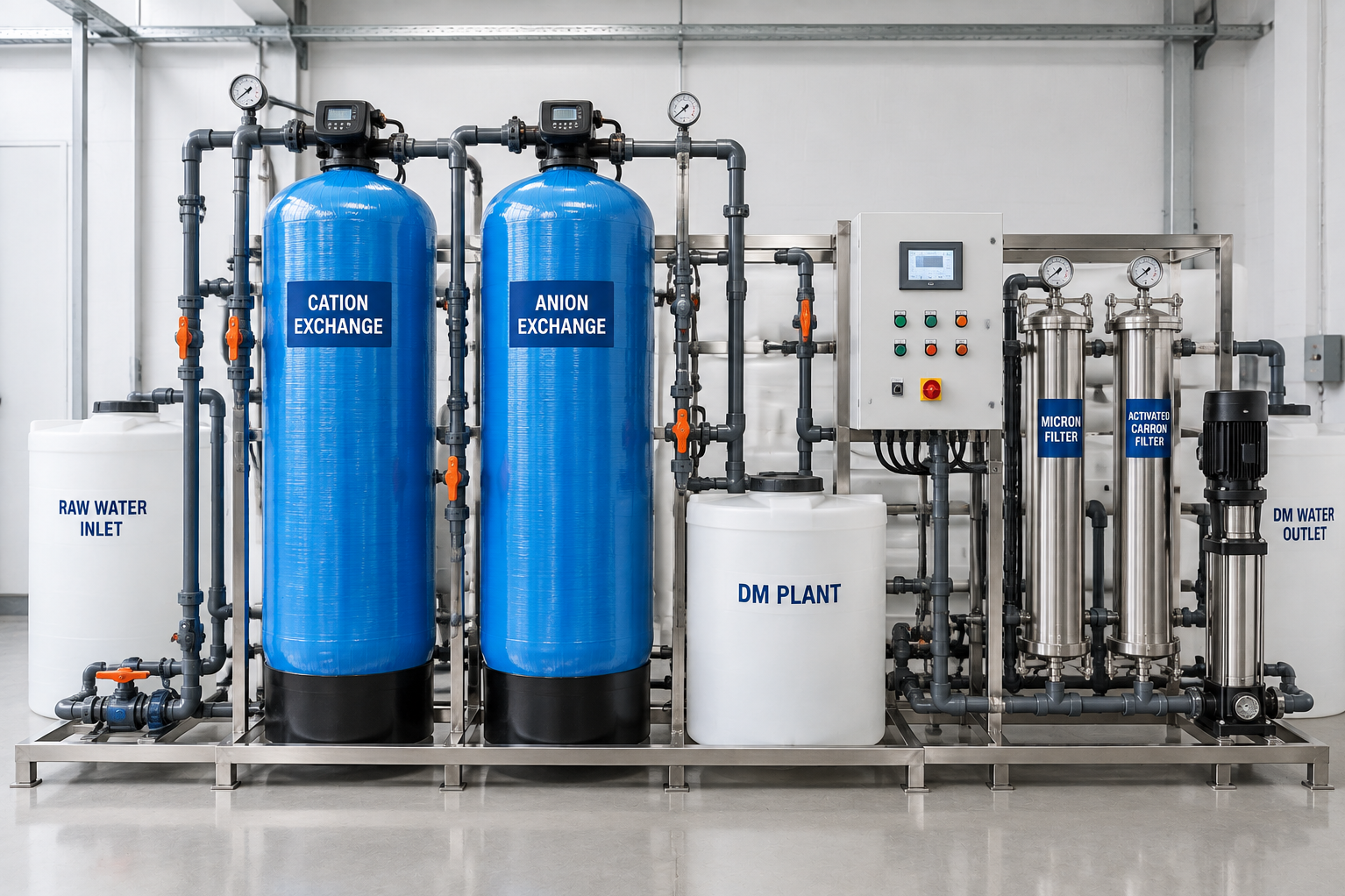
Some industrial processes are sensitive to minerals naturally present in water. Dissolved ionic impurities can contribute to deposits, conductivity, scaling, and process-quality problems where a higher level of water purity is required.
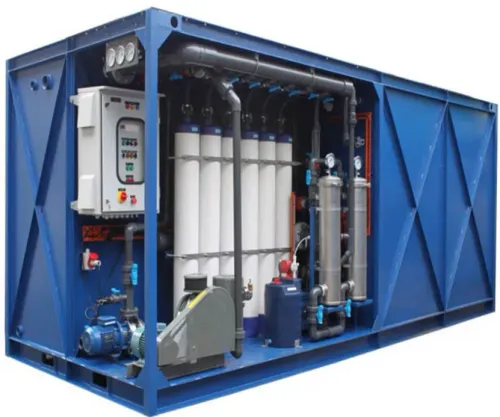
A DM Plant is designed to reduce these dissolved ionic constituents and produce demineralized water for suitable industrial and process applications.
SK Enterprises provides high-purity water-treatment solutions in Nagpur for industries where water quality needs to meet specific process requirements.
How Demineralization Works
Dissolved mineral salts separate into charged ions when present in water.
Demineralization commonly uses ion-exchange materials to remove positively and negatively charged ions.
The required arrangement depends on the chemistry of the incoming water and the purity expected from the treated water.
Different applications may therefore require different configurations.
Which Industries May Need Demineralized Water
Applications can include:
- Boiler-feed preparation
- Chemical manufacturing
- Pharmaceutical processes
- Laboratory applications
- Power-related utilities
- Specialized manufacturing
- High-quality rinsing
Not every application requires the same level of purity.
Defining the final water specification before equipment selection is therefore essential.
Why Feed Water Analysis Matters
Incoming water chemistry influences system capacity and operating requirements.
Testing can identify the ionic load and other characteristics that affect treatment.
If source-water quality changes significantly during the year, these variations should also be considered.
A system designed using incomplete water data may require more frequent treatment cycles than originally expected.
Understand Regeneration
Ion-exchange materials have a finite operating capacity.
Once exhausted, they require regeneration.
Facilities should understand:
- Regeneration frequency
- Chemical requirements
- Chemical storage
- Operator procedures
- Waste streams
- Safety arrangements
These requirements influence both operating cost and plant layout.
Monitor Product Water Quality
Water quality should be checked routinely.
Conductivity is commonly monitored because changes can indicate increasing ionic content, although the exact monitoring requirements depend on the application.
Maintaining operating records helps identify gradual performance changes.
Choose Capacity Carefully
Larger equipment is not automatically better.
Capacity should be determined according to:
- Hourly consumption
- Daily requirement
- Production schedule
- Storage capacity
- Peak demand
- Future expansion
Oversizing increases initial investment, while inadequate capacity can interrupt production.
SK Enterprises works with customers in Nagpur and Maharashtra to assess source-water quality and high-purity process-water requirements before recommending suitable treatment configurations.
A DM Plant becomes necessary when the application genuinely requires low ionic content.
The most practical selection is based on raw-water chemistry, required final purity, daily consumption, regeneration requirements, operating resources, and future demand.
When these factors are established before procurement, industries can avoid selecting high-purity water equipment based only on nominal capacity.